
Itaca: Italy’s First Certified 3D-Printed House Is Complete
2 mins read
10 Feb 2026
WASP has completed the first certified 3D-printed home in Italy, setting a new benchmark for sustainable, off-grid construction using digital fabrication and local materials.
Digitally Fabricated, Legally Recognized
Italy now has its first officially certified 3D-printed house. The project, named Itaca, was developed by construction robotics company WASP as a fully habitable and legally recognized home, not a showcase prototype. The result demonstrates how digital manufacturing and natural materials can combine to produce architecture that is both durable and adaptive.
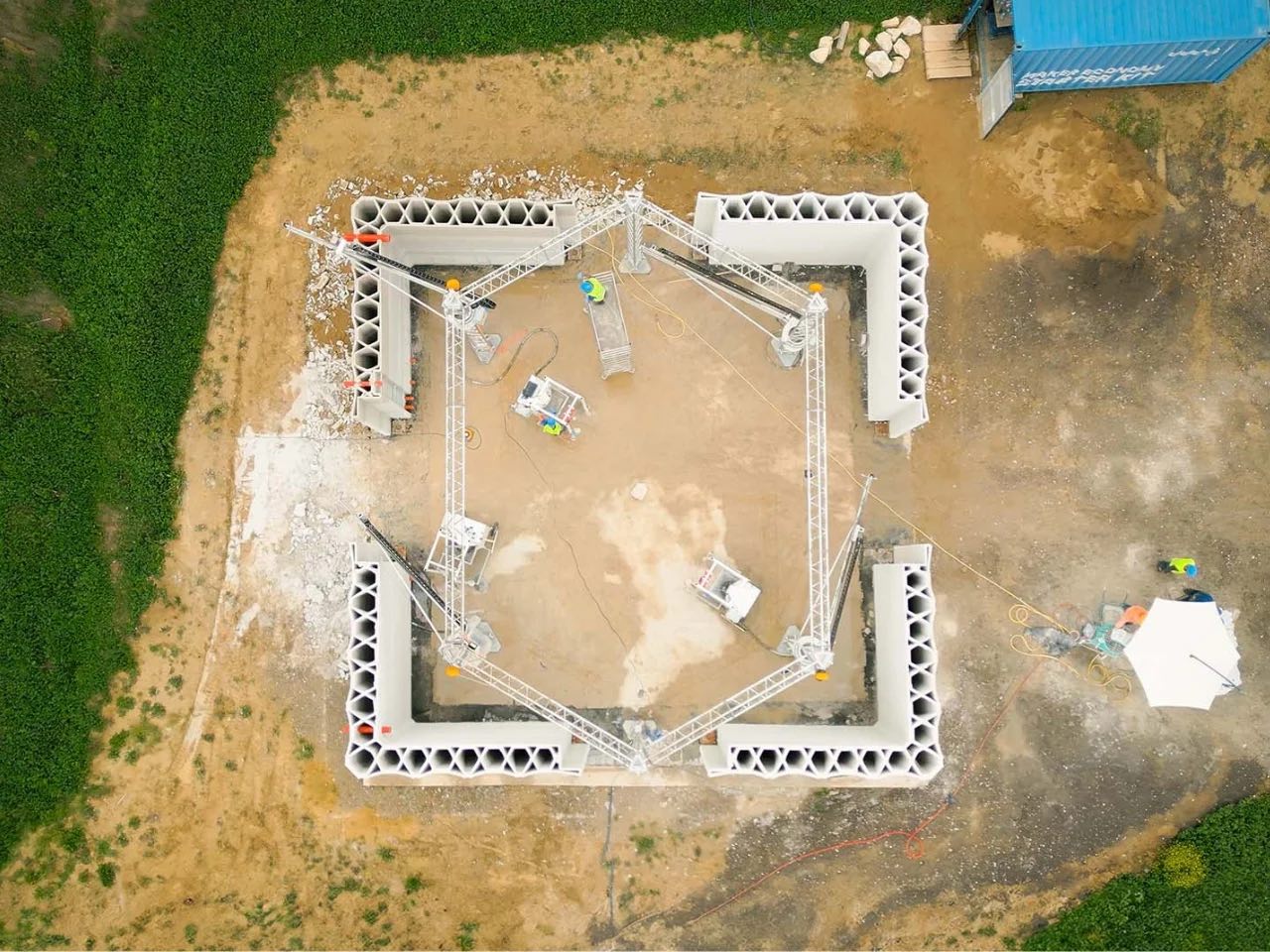
Using a four-arm coordinated robotic crane system, the team printed thick, curving walls made of lime-based concrete, chosen for its thermal inertia. The rapid 3D-printing process enabled construction directly on-site, with forms optimized for passive climate control.
A Self-Sufficient Rural Ecosystem
Beyond its printed shell, Itaca is designed as a self-sufficient homestead. It features rice husk insulation—a byproduct of agriculture—and integrates hydroponic planters (also 3D printed) to produce food locally. Solar energy powers the entire home, creating a modular off-grid model suited to rural or remote areas.
Itaca demonstrates how 3D-printing can offer affordable housing with low material waste, and how circular principles can extend beyond the walls to shape energy and food systems.
Why This Matters in Europe
As Europe tightens expectations for embodied carbon and sustainable building practices, digital fabrication using regional bio-based materials is becoming more relevant. Itaca proves that certified residential 3D-printing is no longer speculative—it can be executed, permitted, and scaled.
The WASP model not only lowers logistics and labor costs but also enables form-driven, site-adapted design with minimal environmental footprint. It opens a pathway for regenerative construction methods across Europe’s diverse climates and terrains.
TecPro View
At TecPro, we see Itaca as a compelling example of how architecture, robotics, and ecological intelligence are converging to create new standards for sustainable living. The project’s off-grid capacity and digital efficiency position it as a model for housing in Mediterranean, rural, or disaster-prone regions.
We’ll be watching how regulatory pathways evolve and whether projects like Itaca are adopted in affordable housing frameworks, EU-funded rural developments, or green tourism initiatives.